Frequently Asked Questions
What to Bring
Please bring your referral letter from your GP or specialist, a current list of medications (including dose and frequency), any relevant prior test results or imaging (nerve conduction studies, EMG, MRI or CT reports), your Medicare card, DVA card, or Workcover/insurer claim details as applicable, and a list of questions or concerns you'd like addressed during the consultation.
Preparing for the Test
Medications
Please let the booking staff know if:
- you are taking blood thinners such as Warfarin (Coumadin®), Apixaban (Eliquis®), or Rivaroxaban (Xarelto®)
- you have haemophilia
- you have a pacemaker or other implanted device
Wearing loose clothing is helpful, so that your upper arms and thighs can be accessed if needed. It is recommended to avoid using body lotion on the day of the test.
If you have suspected myasthenia gravis and you are being referred for repetitive stimulation testing or single-fibre EMG, please contact us as certain medications should be withheld for 12–24 hours prior to the test.
Botulinum toxin (Botox®, Xeomin®, Dysport®) for cosmetic or medical treatment can affect single-fibre EMG results for up to 12 months after the last injection. Please contact us to discuss further.
What if My Symptoms Get Better Before the Test?
If completely resolved, please discuss with your referring doctor. If you have symptoms that come and go, it doesn't matter if your symptoms aren't there on the day of the test; the testing is still useful.
During the Test
Nerve Conduction Studies and Electromyography (EMG)
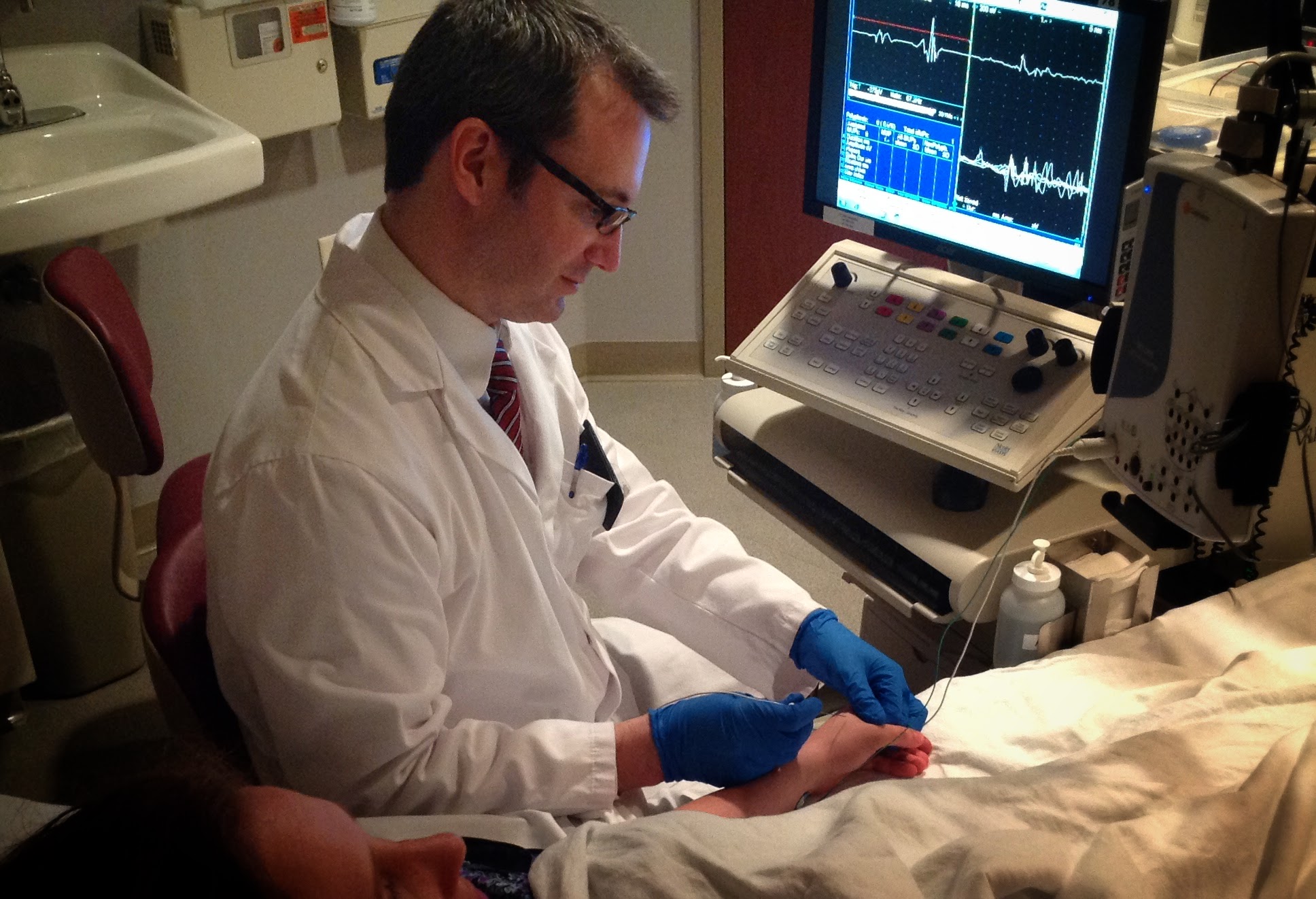
Nerve conduction studies are performed by applying small electrical shocks to each nerve being tested and recording how the nerve works. These shocks cause a quick, mild, tingling feeling. EMG involves passing a small, thin needle (smaller than a blood test needle) into several muscles, one at a time, to see if there are any problems. The electrical signals made by the muscles are analysed.
A good video demonstration of the examination can be found here.
Does It Hurt?
This is a popular question. The answer is generally yes, a little. The amount of pain people feel during the test varies considerably between individuals. When asked to score the pain they experienced out of 10 (0 being no pain, and 10 being the most severe pain), the average was 3–4 out of 10. It is normal to feel a bit concerned before the test, but the vast majority of patients are able to get through the testing without any difficulty. If at any point you want to stop, please ask and the test will immediately be stopped. Learning more about what the test involves — such as reading this page — can reduce the pain experienced.
What Do I Need to Do, and How Long Does It Take?
There is nothing specific you need to do during the test. The doctor will work with you to find a comfortable position. A study of the hands might take twenty minutes; more complicated studies of multiple limbs, or where EMG is performed, might take forty-five minutes to an hour.
What Should I Expect After the Test?
Nerve conduction studies have no significant side effects. After a needle EMG you may experience some mild tenderness or bruising in the tested muscles — this should settle within a few days at worst. If there is bleeding, put pressure on the site until the bleeding stops and see a doctor if it persists.
When Do I Get My Results?
The results are available immediately after test completion and a copy is given to you at that time. A copy is also sent to your referring doctor and any other doctors involved with your care on request.